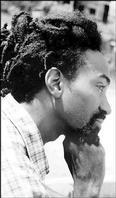
"Tribute to the gay Jamaican poet's book Words to Our Now; I showed this at a presentation I gave at a conference as a supplemental music video interlude; as an example of the beautiful and convicting form of epideictic rhetoric that Glave employs. I got wonderful feedback from Mr. Glave on the video. I am glad he felt honored. His essays inspired me, may do the same for you-- "
18 November 2008
Thomas Glave's work inspires video
"Tribute to the gay Jamaican poet's book Words to Our Now; I showed this at a presentation I gave at a conference as a supplemental music video interlude; as an example of the beautiful and convicting form of epideictic rhetoric that Glave employs. I got wonderful feedback from Mr. Glave on the video. I am glad he felt honored. His essays inspired me, may do the same for you-- "
11 October 2008
15 August 2008
Conscious lyrics?
Conscious deejay Miguel Collins, more popularly known as Sizzla, has advocated murder in at least 35 songs, that's more than Ninja man, Mavado or Munga, yet he still considers himself righteous.The Jamaica Observer has a revealing article on the so-called conscious lyrics of Sizzla, demonstrating that fundamentalism of whatever colour or flavour is toxic to humans. Unfortunately, it is the more visible and vocal Rastafarians like Sizzla who shape the world-view and attitudes of the idren, spreading bigotry and violence across the land. Is it any surprise then that the country finds itself in such a state of anarchy and barbarism when a supposedly conscious artiste espouses and promotes these sociopathic views? It is no small comfort that gays are not the only targets of his ethnic cleansing which would eliminate Pope John Paul II, politicians, policemen, informers, gunmen, and even an innocent taxi driver. Would this bloodlust end by turning the gun on himself as Jah's self-appointed chief gunman?
When impressionable minds of under-educated, hopeless males with low self-esteem, lack of autonomy and insecure in their sexuality are fed a constant diet of "conscious lyrics" like this, it is a form of conditioning that creates delusional power, a megalomania which manifests in the slaughter we are now suffering. Any innate feelings of love, compassion or altruism are swept away in a flood of adrenalin and testosterone triggered by fear, inadequacy and paranoia. The autotoxicity has to stop but it can only begin after we recognize that we are destroying ourselves and instead, feed our minds with enlightened, uplifting thoughts.
The gun may give marginalised males temporal power which lasts only until they are brought down by the gun. True, lasting power is derived from healthy self-image and self-esteem that gives rise to autonomy and self-actualisation. The individual grows, the society thrives.
02 August 2008
Gays, Africa, Two Spirits, and Astrologers
Many ancient and traditional cultures have had the wisdom to reserve special roles for persons who displayed other than heteronormative behavior. These gifted ones would be recognized in childhood and raised differently, often as transgendered as they were thought to have two spirits. They were regarded as "good medicine" by North American tribes and, naturally, as intermediaries between earth and heaven, this world and the next, due to their synthesis of both male and female polarities. They would become the tribes' or societies' priests, shamen or soothsayers; in some West African traditions they were known as gatekeepers who controlled the portals to the divine. Such a role is given to Elegba in the Orisha tradition where he oversees doorways, entrances and crossroads. In his Haitian manifestation as Papa Legba he is the loa of gays.
We have retained much of our African spiritual roots in the syncretic practices of Pocomania, Kumina, Myal and Revival. It would be logical to expect that an intermediary role of some description would have survived and be ascribed to two-spirits. There is a strong homosexual dynamic at play in the phenomenon of a male adherent being "ridden" by a male deity.
Unfortunately, the homophobia that prevails in Jamaica would preclude any academic study of this aspect of our heritage; scholars who happened to be homosexual would not risk being outed by association, and straight ones would not wish to become tainted, even for the sake of intellectual pursuit. By now we should have deconstructed much of our African past, our slavery experience and the effects both have had on our collective psyche. Alas, our centers of learning have not the academic and intellectual freedom to free our people from mental slavery. The majority of our people will continue to labour under the delusion that homosexuality is a latter-day phenomenon inflicted on black people by white colonials. The irony is that it is to the fundamentalist Christianity and anachronistic laws that were used by the white masters to control the natives that we now cling so defensively.
Emancipendence fartit ... er, platitudes
We must hasten to ensure that every Jamaican, while fully respecting the needs of others, will not be impeded in the enjoyment of those inalienable rights and freedoms. In order to do this, we must urgently conclude the new Charter of Rights and Freedoms which provides a wider and more effective protection of those rights and freedoms to which every Jamaican is entitled.
- Governor-General Professor Kenneth Hall
When individuals and communities are forced to live in fear, their condition is not much different from what was experienced under the slave masters ... When we sow seeds of disunity and set one against the other, we are employing the same tactics used in slavery. When we disrespect each other, we are behaving just like the slave master who disrespected us ... Being a free people means that we must respect each other's freedom and the right of every one of us to live peacefully and seek after our well-being.
- Prime Minister Bruce Golding
Issues of rights and freedoms need constant attention ... neeed constant reviewing, fine-tuning and updating ...
- Opposition Leader Portia Simpson Miller
Can LGBTQ Jamaicans feel that they are full citizens when their consensual behavior is criminalized, they are attacked and assaulted at will, hounded out of home and job, set upon in the streets, victimized by the police and deprived of constitutional protection? Until the relevant sections of the Offences Against the Person Law are removed and discrimination on the basis of gender and sexual orientation outlawed, the majority of us will continue to live in fear, stress and despair.
We are accustomed to the prevailing hypocrisy so attach no significance to the high-sounding seasonal releases from our leaders. If you thought for a minute their rhetoric included us, your delusion is forgiveable as the desire for freedom is unquenchable in the face of all hostility. None of them have lifted a finger to help us. Social attitudes are difficult to change but real leaders lead; they have an obligation to show a higher way, a broader horizon, larger possibilities. But i forget, we're still on the plantation and it's as much as the overseers can do to keep it running.
10 June 2008
Thomas Glave blasts Golding
May 27, 2008
In response to the latest episode of a Jamaican (you know who…) embarassing himself and the rest of us by confusing nationalist sentiment with informed political discourse, Thomas Glave posted his statement at Calabash on the queer Caribbean listserv:
Dear C-FLAG Listserv community,
Yesterday (May 23, 2008), in Jamaica, at the Calabash Literary Festival in Treasure Beach, where I still am, I read selections from my new, just barely published edited anthology Our Caribbean: A Gathering of Lesbian and Gay Writing from the Antilles; in fact, this reading opened the Calabash weekend. However, given Jamaican Prime Minister Bruce Golding’s recent antigay remarks on the BBC-TV show “Hard Talk,” about which there has been much discussion in the local Jamaican press, I felt that I could not read from *this* book in particular, *in* Jamaica, without expressing my unhappiness over Mr Golding’s remarks. Because I’m not certain if the J’can press will carry any coverage of what I said, here are my remarks, addressed to the large Calabash audience, that preceded my reading. The response – at least from what I could tell – was overwhelmingly positive, even eliciting applause before I barely finished a few sentences:
“I want to say a special thanks to the Calabash organisers – Colin Channer, Kwame Dawes, and Justine Henzell – for inviting me back to Calabash, this being my second reading at the festival, and for their unceasing generosity to, and support of, writers from around the world. And so, mindful of that generosity and kindness, my conscience will not permit me to begin reading from this book in particular before I say that as a gay man of Jamaican background I am appalled and outraged by the Prime Minister’s having said only three days ago on BBC-TV that homosexuals will not have any place in his Cabinet and, implicitly, by extension, in Jamaica. I guess this means that there will never be any room in Mr Golding’s Cabinet for me and for the many, many other men and women in Jamaica who are homosexual. And so I now feel moved to say directly to Mr Golding that it is exactly this kind of bigotry and narrow-mindedness that Jamaica does not need any more of, and that you, Mr Golding, should be ashamed of yourself for providing such an example of how not to lead Jamaica into the future. And so, Mr Golding, think about how much you are not helping Jamaica the next time you decide to stand up and say that only some Jamaicans – heterosexuals, in this case – have the right to live in their country as full citizens with full human rights, while others – homosexuals – do not. That is not democracy. That is not humane leadership. That is simply the stupidity and cruelty of bigotry.”
I then read excerpts from the work of 4 contributors in the book: Makeda Silvera ( Jamaica ), Reinaldo Arenas ( Cuba ), Helen Klonaris ( Bahamas ), and my own, and finished by saying, “Not just one love, Jamaica . Many loves.”
I felt terrified, to say the least, to make this statement before the reading; never have I felt so vulnerable, so exposed, and, before I walked up onto the stage, alone. But feeling embraced by the warm reception, I left the stage feeling more than ever that the title of Our Caribbean indeed speaks a truth: that this is, and will continue to be, through struggle, our Caribbean.
In solidarity, Thomas Glave
21 May 2008
Hard Talk
I'm not surprised at the PM's response in light of what he's previously said. However, on this occasion he did himself and his country a disfavor, passing up the opportunity to display the level of statesmanship and inspired leadership to which he aspires. I'll never forget how impressed i and thousands of others were when he distanced himself from old-time politics when he formed the NDM. I wonder what happened to that Bruce Golding? How progressive is it to reinforce bigotry and pander to ignorance?
13 February 2008
Kenneth Reeves speaks out
To the men and women of the elected government, Prime Minister Bruce Golding and other local and national representatives-- the purpose of this February 14, 2008 rally is to say we are speaking out as the first critics of the barbaric treatment of homosexuals in Jamaica, which is unchecked by the police. We are also aware of and reject the explanations offered as to how these incidents are either not what they seem (lovers quarrels, unrequited love, etc) or how quiet homosexuality has always been a part of a Jamaican life since there are prominent homosexual individuals in the Jamaican government and religious communities who are understood to be necessary and valued parts of Jamaican society.
02 February 2008
This guy needs support

Constable Michael Hayden is a very worried cop. But he is not scared of gunmen or other criminals. He is afraid of some of his colleagues. He claims they are trying to force him out of his job because of his sexual orientation.
While the 24-year-old constable admits to THE STAR that he is bi-sexual, he says some officers at the Manchester police division, where he is stationed, have been accusing him based on mere suspicion after an incident when he was almost beaten by a group of men in May Pen, Clarendon.
- The Star, 2008/2/1
This cop has no protection from the constitution of Jamaica. His superiors can fire him on any pretext and there is no one for him to appeal to. He's to be commended for coming out publicly in the way he has; such courage, some would say foolhardiness, is uncommon. Will he tough it out in Jamaica, if he's not killed, or will he escape to more accommodating parts like others who've come out or been outed like Digicel Rising Star Kyino Cunningham who i heard was shipped out to Japan by his mother?
We cannot look to the Golding administration for any relief from the obsolete laws which set the tone for the homophobia which prevails. If the Lawyers Christian Fellowship had their way, even more stringent sanctions would be written into the law and constitution. The last i heard, no one was agitating for same-sex marriage in Jamaica but i suppose they want to pre-empt any such notion.
22 May 2007
Ruth Doorbar, part of our history
17 May 2007
Catchup
So much has been reported lately that i'm hoping it'll generate some comments and exchange. There have been the gay-bashings at Tropical Plaza, the MoBay carnival, the Mandeville funeral and the Falmouth drag queen. The silver lining to the cloud could be the outcry by Bishop Herro Blair and Jamaicans for Justice calling a for a halt to the anti-gay violence, and the mostly supportive editorials and columns which have followed this rash of incidents. This seems like a slight shift to me. Then Public Defender Witter had to put his mouth in it, basically telling gays to lap them skirt.The positive news has been all about the Sunshine Cathedral outreach and planting of MCC among a number of congregations. It would be great to hear from some of those involved. Give us the inside story, nuh?
12 February 2006
Thomas Glave Interview in The Gleaner
THOMAS GLAVE delivered a reading of his collection of essays Words to Our Now: Imagination and Dissent, published by University of Minnesota Press, at Redbones the Blues Café, recently. Glave is an assistant professor of English at Suny Binghamton in New York. Though born in New York, Glave is of Jamaican descent and he shares his identity between both countries. The collection tackles issues of hatred and prejudice that ranges looking at homophobia, racism in the United States and the war in Iraq. In an intriguing exploration of identity, Glave refers to himself as "a living, breathing oxymoron: a Rasta b...man". In the following interview, he speaks of the collection, prejudice and anti-homosexuality in Jamaica.Tanya Batson-Savage: Your earliest piece in this collection, 'Baychester: A Memory' is dated 1994 and there are pieces from 1999, 2000, and 2002 moving through to 2004. Were these essays always conscious parts of a collection?
Thomas Glave: No. I had no idea when I wrote Baychester that it would someday be included in this book. A few of the essays were written as public addresses/lectures, including a talk I did at UWI, Mona. It was only after a relative suggested a few years ago that I would soon have enough material for a book of essays that I began thinking of these works collected together, although around the same time I had begun thinking of assembling an essay collection and had even come up with a title for it a different one than the one I ended up using.
TB: What led to the selection of the title 'Imagination and Dissent'?
TG: That subtitle seemed best to encapsulate what this book embodied: Writing that used language imaginatively, creatively, experimentally, but also forcefully dissented against (for example) human rights violations, the war in Iraq, U.S. foreign policy, the harmful effects of globalisation, etc.
TB: You were born in New York and you now teach there, but much of Words to Our Now is concerned with the state of Jamaican society. How much of your youth was spent in Jamaica?
TG: A great deal of my youth was spent here, starting at a very early age as early as two or three. This isn't unusual; a lot of Jamaican families abroad ensure that their children spend time back 'home'. I was very lucky in that regard. My parents always made sure that I spent extended time with family in Jamaica.
TB: You have described yourself as an in between man, because of your identity which is shared between Jamaica and North America. Is this in betweenness a good or a bad thing?
TG: It's neither good nor bad it just is. It's a kind of hybridity, a new kind of Jamaican identity, one that comes out of both places and moves between both places. I am a diasporic Jamaican, a child of the massive Jamaican diaspora. There are thousands of us, if not millions. In my case, it's all complicated deepened by my homosexuality.
TB: Much of the politics of hatred which you attack surrounds the intolerance of Jamaicans for homosexuality, but you have other politics of hate dealt with in the text. Do you believe all hatred is the same?
TG: All hatred is the same in one sense; hatred always, first and foremost, diminishes the human spirit and possibility of the person who hates. It is a negative, usually destructive force. But people hate differently and for different reasons. Black people everywhere, including Jamaicans, are hated looked down on in much of the world today and so are gay people, Jews, Muslims, and other people. What does this teach us?
TB: Do you believe Jamaica has received fair play in the international press regarding our homophobia? That is, there is much talk about how intolerant we are of homosexuality, but it is usually said in a generalising fashion that suggests all Jamaicans hate homosexuals. However, some would argue that there is an increase in tolerance here. What is your position on this?
TG: It's complicated. Jamaica is, without question, an extremely intolerant, homophobic society. It's high time we stopped trying to dodge this truth and faced it honestly. If we don't, we'll never grow as a people. Very few people in the Jamaican media so far have asked Jamaican homosexuals to talk about how they feel about Jamaican homophobia.
It isn't up to Jamaican heterosexuals to determine how homophobic Jamaica is or is not, since they don't suffer the antigay oppression that those of us who are gay or lesbian suffer. At the same time, I do think that things are beginning to change for the better in Jamaica, although very slowly.
I would like to think that I've seen some significant changes in the middle class, which is the part of Jamaican society I know best, coming from it. Even a few Jamaican ministers and priests in Jamaica have become a little more progressive on the issue. The entire world is changing on the issue and Jamaica will have to move with that change, especially if it wants to avoid becoming truly repugnant to the rest of the modern Western world. It is a sad fact, and a big problem, that a lot of people out there regard Jamaica as a country of backward, ignorant black people who continue to resist inevitable social change.
TB: If you do not agree that there is an increase in tolerance, what do you think can increase tolerance of sexual orientation?
TG: We've never wanted to talk about homosexuality in Jamaica, right? Not unless we are vilifying it or gossiping negatively about it. We need to begin talking about it constructively that is, we have to find ways to make our family and friendship spaces more welcoming to the gay people among us. If we don't, those people will remain hidden and unknown to us and some of those people could be our husbands, wives, fathers, mothers, grandparents, best friends, church members.
TB: What role do you believe the media has to play in stemming intolerance? Do you see signs of this happening?
TG: The Jamaican media, like all media everywhere, needs to become more intelligent and sophisticated in how it discusses the issues. We need less sensationalisation (such as we see often in the Jamaican tabloids) and more in-depth, sensitive reporting. We also need the media to understand that homosexuals do not spend all our lives thinking about sex, any more than heterosexuals do. We are complex human beings, just like you. More interviews like this one, I think, will help.
TB: You have suggested in the past that the literature department at the UWI should "queer" its curriculum.
What role do you believe this has to play in the larger society?
TG: UWI educates people; that is its job. In a university environment, full, complete education means inclusion of all sorts of topics for discussion. We're not doing our work as educators (and I am a literature professor) if we don't expand our curricula. We're also not doing service to gay and lesbian UWI students, and to everyone, if we refuse to add gay and lesbian material to the curriculum.
Also, gay and lesbian courses are being taught in just about every major university in the Western world now. 'Queer Studies' is an expanding field and offers enormous opportunities to Caribbean scholars. UWI risks becoming a second-rate, intellectual joke if it doesn't keep scholarly pace in this regard with other, international universities. That's what university systems should do - inspire each other to grow intellectually.
TB: You describe yourself in 'Following the Body Divided: Hair' as a "Rasta battyman". Is that a case of appropriating the word to rob it of its power? Can such a word be actively appropriated?
TG: It depends on who is using the word. ("Battyman", by the way, is not a word I ever heard anyone in my family use - and I'm sure that none of my family would use that word.) The word can be appropriated if I decide I want to appropriate it - and I did. I like the idea of calling myself a Rasta battyman: I am being a little playful, a little humourous and simultaneously showing that words can indeed be turned around to rob them of their negative power.
TB: You suggest that your hair acts as a mask a sort of protective shield against accusations. Was it a deliberate disguise or a happy circumstance?
TG: It was more of a coincidence. I didn't grow my hair to ward off accusations, in Jamaica, that I was gay. I didn't grow my hair as a 'mask'. But the very fact that I felt concern about being targeted as gay in Jamaica should give you some idea of what we go through all the time as gay people here - the fear and tension we experience, especially since there are virtually no J'can laws to protect us. Yet.
TB: Many lay continuing homophobia on the lips of DJs. Do you believe that this is disproportionate blame and anti-homosexual lyrics are merely a reflection of prejudices which are firmly rooted in the society?
TG: You say 'merely' a reflection; that is a huge 'merely'! I think that DJs have enormous influence among young people and could be singing about more crucial issues in J'can society, following the powerful examples of Bob Marley and Peter Tosh, e.g. When we have so much violence, poverty, and injustice, why do the DJs continue to sing about killing homosexuals? Why don't they sing about stopping violence and building communities? Why can't they sing about the benefits of an education and the need to take better care of our children? I'll tell you why; because it's fashionable and profitable to sing about "battyman fi dead" and those songs will sell. These antigay prejudices may be, as you suggest, "firmly rooted" in the society, but no society is cast in stone and every society must either eventually change with the rest of the world or die.
TB: 'Regarding a Black Male Monica Lewinsky, Anal Penetration, and Bill Clinton's Sacred White Anus' tackles the issues of race, sexuality and politics. Do you think the world is at all ready for an openly homosexual leader?
TG: What we call "the world" never seems to be ready for anything until it happens. Was "the world" ready to see Jamaica become an independent nation governed by its own people? I think that, at least in the west, we are more than ready for an openly homosexual leader. Why not? An example: the three-time elected mayor of Cambridge, Massachusetts - the city of Harvard University and MIT - is an openly gay man of Jamaican background Kenneth Errol Reeves. We should, all be very proud of him and be inspired by his 36-year relationship with his partner, Greg Johnson.
07 January 2006
The full story
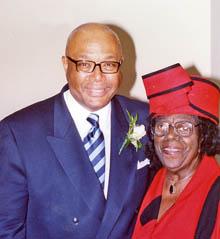
The Gleaner was quick to report that a Jamaican, Kenneth Errol Reeves, has been elected mayor of Cambridge, Massachusetts, for the third time. What the article left out was that Reeves is openly gay, celebrating with his partner, Greg Johnson, their 36th anniversary this week. I don't know if the information was not available to the contributor, one Wilmot Max Ramsay, whether he considered it not of interest to include it, or if he did include it, whether the editors blue-lined it. Whatever the circumstances, the net result is that once again the full story of LGBT persons as upstanding contributors to society and as sources of pride is not told.Photo shows Ken Reeves, newly re-elected mayor of Cambridge, Massachusetts, with supporter and City of Cambridge employee, Zelma Evelyn. The contender beaten by Reeves, E. Denise Simmons, is lesbian. See full story.
For too long LGBTs have been written out of history by the prevailing heterosexist, Judeo-Christian moralists in their attempt to create a false "purity." Similarly, the chauvinists are trying to defend "Jamaican masculinity," claiming that homosexuality is un-Jamaican, un-black, white man's corruption, etc. When there are no countervailing images or messages in the popular media, then people, critically impressionable young LGBTs, get a warped view of themselves.
Blacks are quick to claim their own achievers throughout history; Jamaicans claim with pride their nationals who excel all over the diaspora. As LGBT Jamaicans, we can do the same. Information is now readily available so it will become increasingly difficult not to know, unless one chooses to be deaf and blind. It does require, though, that we become vigilant and act promptly to correct media distortions and abuses.
19 December 2005
18 December 2005
Involvement
Turning apparent weaknesses into strengths has been one of the operational principles of the Jamaican Economy Project. Rather than relying solely on talent close to home, the project has taken advantage of Jamaica's intellectual diaspora. In the process, it has activated a virtual university of sorts. Exploiting modern communications technologies, from the Internet to teleconferencing, the project has succeeded in uniting Jamaican scholars around the world with those at home, around a shared commitment to bring their knowledge to bear on the country's future.
UNIQUE PERSPECTIVE
Moreover, continues Miss Minto, the experiences of other researchers like her, young, still a bit idealistic, and solidly rooted in Jamaica though they work and live abroad offers a unique perspective on old problems. "Our eyes," she points out, "have not been clouded by the entrapments of politics and political affiliation. As such, our present location in foreign lands has allowed us to fly free of the nets of politics, to speak as independent and empowered individuals who are able to view our nation more objectively.
Indianna Minto's future looks bright. In the final stages of her doctoral dissertation, she has already landed herself work at Oxford University's Said Business School. Yet she hopes that she can bring some of that same optimism to bear on her country. She reflects, "No Jamaican, by virtue of youth or country of residence, should absolve himself of the responsibility to help in his country's advancement. By participating in this project I am acknowledging this fact and in so doing, making a small but what I hope will be a significant contribution to Jamaica.
There are many lessons we can draw from this as we engage the process of bringing Jamaica's human rights record with respect to sexual minorities in accord with prevailing standards.
I also found an article in The New York Times reflective of our own situation. It recounts the struggle of young Tibetans exiled in India to recreate their identity and hopefully reclaim their homeland. Speaking of Tsundue, a young poet-activist:
... he was focused on his plans to set up a public library and reading room in Dharamsala. Tibetans like himself, he said, needed to read more than books about Buddhism and the other religious texts that were available to them in Dharamsala. They needed to know about the modern world; above all, they needed to know about China. Reading rooms and libraries, he said, are where new political ideas and movements begin. As the Tibetans gathered around Tsundue's table nodded, I couldn't help thinking that this was how Tibet's adversary Mao Zedong began his career.
This was the sort of thinking behind the establishment of a library by the Gay Freedom Movement, back in the day. That library was ceded to J-FLAG. What is the status of it now? Can it be renewed as the beacon of our re-education and inspiration? I'm sure the much-maligned foreign-based activists could be persuaded to add this as a project to their infamous agendas.
17 December 2005
Re: Outraged
It appears vulgar to be having a discussion seemingly on the corpse of a good friend. But based on my own personal relationship with both Steve and Brian, my work in issues of LGBT rights and now with HIV and human rights, I feel entitled to make some comments.
To begin, I hardly think that gay rights activists (local and international) are responsible for any kind of indecent eposure. Newspapers are always going to report in a reductionist and sensational manner. A life's work will be reduced in one's untimely death with only the tag of sexual orientation. And that is sad, because clearly, a person must be more than just his sexual orientation.
However, the issues of sexuality that stalk the death of many gay men, is worthy of discussion. I am happy that a senior police believes that there is need for special oversight of the way murders with a perceived homosexual subtext are investigated. This , I beg to say, is not a call for "special rights". Complaints that the police have often refused or been breathtakingly inadequate in investigating crimes against gay people, is not a figment of some foreigner's imagination. As it now stands, the class of persons called homosexuals (also described as "vulnerable people" in relation to HIV an AIDS) have no rights. In fact, male homosexuals could even be styled unapprehended criminals, by law .
This is a difficult conversation to conduct, even among gay people and those who are "gay-friendly". We really should be focussed on mourning the loss of a dear friend . In fact, we really shouldnt be burying anyone in these circumstances. But we are. And activism geared to change some of the institutional things that make some murders happen with impunity, is actually worthwhile.
Yes, there are many murders that occur in Jamaica with a whole range of victims. But there is a particular way that some murders occur. Even worse, some are motivated by who the victim is. Sometimes the system even seems to conspire to make some murders occur with no redress. And what do we do, if we happen to fall in a category that puts us at risk? Well we can grieve, reflect, honour the dearly departed and take steps to ensure that this doesnt happen again. But we cannot just sit back and love all the hurt away.
There is no doubt, that distance and economic status can make a difference in any kind of activism. Much is said about people who have the luxury of being overseas and continually "fass" in local [Jamaican] business. I also recognise that being middle class does sometimes act as a buffer for both men and women, in respect of homophobia. But I will also say that that none of these things disentitle anyone from an opinion on these important issues. Murder and repression are not private matters. I believe all well thinking persons, gay, straight, rich, poor, Jamaican or foreigners, can feel involved with these issues. As a dear friend of mine said recently, we all carry the "psychic burden" of Jamaica's violence. I believe that the cry for change, expressed in part by activism, is an attempt to save our country and all Jamaicans both inside and outside.
Peace
Philip
Re: Outraged
We have not spoken since your own ordeal. I'm happy you were released relatively unscathed. It must have been a harrowing experience.
This must be a very trying time for you again. In addition to the grief at Steve's death, there is this anger. I'm not sure exactly how your sensibilities have been offended or your expectations not met, but i'll make a few observations, even from a distance, if i may.
To date, i have not seen any release from JAS, the organization with which Steve is associated and with whose work he has been identified. Was there any attempt at media management to influence what was published? To whom did the press and stake-holders speak? If there was no communications oversight, then the press could have had open-season on this. As it was, i have not seen any press reports or releases from NGOs or anyone which describe him as a "Gay man," except from the Guyana National Aids Committee, much less as a gay activist.
Invariably, the issues of homosexuality and AIDS are conflated in the average Jamaican mind. People are killed in Jamaica every day, unfortunately, but if a well-known HIV/AIDS prevention worker is the victim, then the question of gay murder/hate crime inevitably will arise; "proof" is unnecessary, as the general perception/conjecture will prevail even in the wider society. If Steve was not out while alive, he has been outed in death, perhaps adding another dimension, as you project, to his family's grief. Beyond the "newly and freshly growing relationship with his family," he chose his lifestyle, companions, involvement, commitment and public role. He was part of the community and his gay family is going to claim him. I daresay he is seen by them as a model, on which were projected many hopes, now transformed into yet another gruesome materialization of their fears.
JAS is not a "Gay" organization despite the fact that it was conceived and is run by gay men, and many of its programs are MSM-oriented, even to the spawning and harboring of J-FLAG. In the social and political climate of Jamaica, it has to maintain distance, perhaps even to dissemble at times. This is the default survival mode of the majority of LGBTs and PWAs in Jamaica, leading to ambivalence, conflicting feelings and a grave sense of dis-ease. It's all an open secret, propped up with hypocrisy, deception and denial of self. When story come to bump, as it has here, how we would like to appear bucks up into the reality of how we are perceived.
Your support of and contribution to the AIDS prevention effort, and by extension to the gay community, is noble and highly appreciated. We need all the allies we can get. We respect differences of opinion and approach both within and without the gay community, but to lash out blindly at "members of the GLB," local and foreign-based, and to attribute a "selfish response on the part of activists" does not honour the struggle that Steve and countless others must endure just to survive on a daily basis, and to hopefully arrive at self-acceptance. I hope that the quibbling by some over the method and class of crime is not an attempt to sanitize Steve's life and death to ameliorate anyone's discomfort with how he lived and died. His death should be an occasion for us to comfort and support each other, honour and celebrate who he was, and to draw renewed courage and resolve to resist the continued demonization of sexual minorities and PWAs. Your anger would be more constructively directed at the ignorance and brutality of a society that forces us into hiding, self-denial and self-destructive behaviour of the type reported at Steve's memorial.
I would ask that you state your case directly, not by implicating nameless and faceless GLB and activists; in particular, i ask you to clarify the selfish response that has upset you so. If i have misinterpreted anything you said, or if you have information on any self-serving agendas of activists, referred to as well by Ingrid, i would appreciate hearing, as i am not aware of any discussion beyond this list.
With Love and Support,
Larry
Outraged
"Steve did what he did, with marginalised communities, because he believed in it."
I am not a member of the gay,lesbian, bisexual or "anything else" community. I was "born" heterosexual but was fortunate enough to spend and engage most of my adult life in love, friendship and hopefully an outside understanding of the GLB ... For the past 15 years I have "chosen" to work with the community in its work to prevent HIV and AID's prevention with all communities and within that, much work solely working with people who identified (or not) with being gay and helping them and their families to understand and acknowledge the issue of identifying as GBL ...
I am however as a friend of Steve Harvey's for the past 10-13 years, so angry about what has resulted from his death. Steve was a sweet and gentle giant who had learned to accept with difficulty his sexuality, as have most folks. He would I feel be mortified, by what he sees happening now... The newly and freshly growing relationship with his family surrounding his sexuality was just beginning to blossom, and as we all know that takes time, patience,love and belief.... What can his family and friends feel now. "Steve Harvey , well known gay activist. " (in the press) He wasn't a gay activist, he fought for people with HIV/AIDS and in his own small way maybe brought the whole "gay ' thing into it." That is what Jamaica AIDS Support
has always been about. Not separating but trying to incorporate.
I am saddened by the response and I believe a selfish response on the part of activists that I "no longer" feel I have much faith in. I am really saddened.
Christine
16 December 2005
Re: Who killed Steve Harvey
In Steve's case, the sketchy details I've heard seem to strongly indicate that he may have been 'set-up'. This supposed asking the other 2 young men IF they were gay and opting to tie them up, but take Steve seems too highly thought out and logical to me.
What is true is that our leaders, fellow-jamaicans, colleagues e.t.c. remain relaxed and inactive in the face of the hatred and discrimination that is part of the fabric of many of our lives.
Hatred and discrimination combined with internalized homophobia, self-hate, lack of respect for our selves and our fragile community all too often becomes the gift we give ourselves e.g. the disgraceful melee at Steve's memorial at JAS on Sunday... my suspicion that something of this nature would occur is why I did not attend ... that's not how I want to remember Steve.
There is SO much 2 B done ...
fabian
Re: Some thoughts on Philip's and Ingrid's comments
On a personal note, after taping a pilot programme which explored Jamaica's homophobia, on which I was 'the openly gay man'.....I really thought about what this being broadcast in Jamaica would mean. To me, my safety, peace of mind, my family ....I unashamedly and unapologetically asked the producers to edit out the sections of the show that featured me talking about being gay. The writing, directing, activism I'd like to do are definitely adversely affected by the fact that I currently live in Jamaica.....while doing a consultancy in Trinidad I was struck with delight and sadness at how much more comfortable, safe and relaxed I was there than in Jamaica......Relocation is becoming an increasingly seductive, comforting and life-affirming thought, course of action.
fabian